
Hidden camera detectors can help identify some surveillance devices, but they are not a guarantee of privacy. Their effectiveness depends on the type of camera, whether it is transmitting, how well the room is searched, and the quality of the detector being used.
For travelers, renters, employees, and homeowners, the most useful approach is to understand what these devices actually detect and to combine electronic scanning with a careful visual inspection.
How hidden camera detectors work
Most portable detectors use one or both of two methods: radio-frequency scanning and optical lens detection.
Radio-frequency scanning
RF detectors search for radio signals produced by devices that transmit data wirelessly. A camera sending live footage over Wi-Fi, Bluetooth, or another radio protocol may create a detectable signal. The detector can alert you to nearby activity and may help indicate the general direction of the source.
However, an RF detector does not necessarily identify a camera specifically. It may also respond to ordinary electronics such as wireless routers, smartphones, smartwatches, baby monitors, and other connected equipment. Signal strength can help with a search, but every alert needs to be investigated rather than treated as proof of surveillance.
Optical lens detection
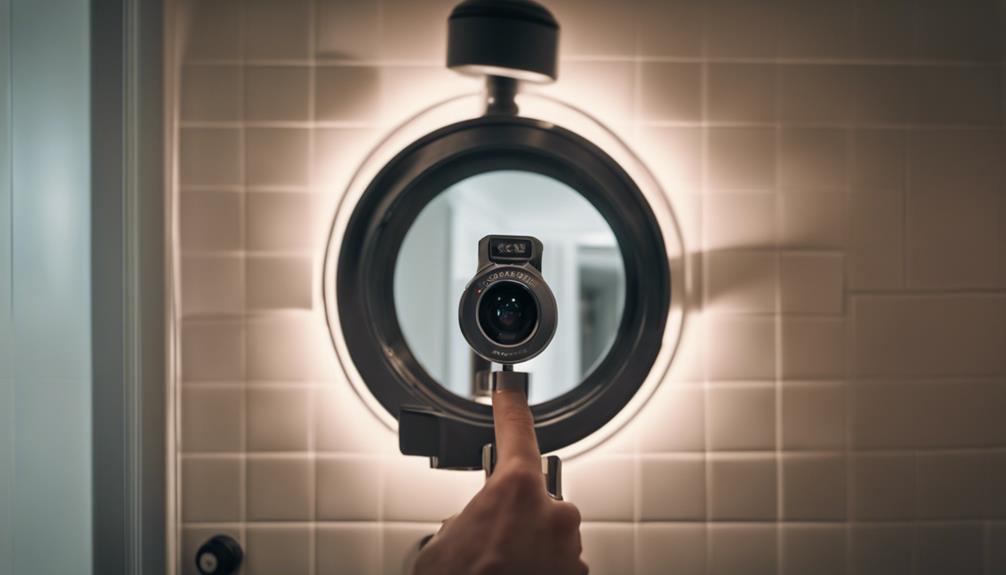
Optical detectors, sometimes called lens finders, use bright light and a viewing lens to reveal reflections from camera lenses. When you scan a room, a concealed lens may appear as a distinctive glint that differs from nearby surfaces.
This method can find a camera whether or not it is transmitting, but it requires a slow and methodical search. Reflections from picture frames, light fixtures, metal objects, glass, and other surfaces can create distractions or false indications.
When do these detectors work?
They are most useful when the device matches the detection method. An RF scanner may locate a wireless camera that is actively transmitting. An optical detector may reveal the lens of a camera that is recording locally or is otherwise silent over the air.
Neither method is reliable in every situation. A camera that is switched off, recording to internal storage, or connected by a wired network may not trigger an RF detector. A camera concealed behind an obstruction, embedded in a wall, or disguised within an ordinary object may also be difficult to locate visually.
For that reason, a dual-mode detector generally provides broader coverage than a device using only one method. Even then, a sweep should be viewed as a risk-reduction measure—not proof that a room contains no recording equipment.
Limitations and common sources of false alarms
Consumer detectors can be affected by the environment and by the equipment already operating in the room. Signal interference, clutter, room size, and nearby networks may all complicate an RF scan. Optical scanning can be slowed by poor visibility and confused by reflective décor.
Professional or carefully concealed installations may require more advanced equipment and expertise than a handheld detector provides. If the consequences of surveillance would be serious, consider seeking a professional technical surveillance inspection rather than relying only on a consumer product.
What to look for when choosing a detector
When comparing products, consider the following features:
- Detection methods: A combination of RF scanning and optical lens detection offers more ways to find a device.
- Adjustable sensitivity: Sensitivity controls can make it easier to separate strong nearby signals from background activity.
- Clear alerts: Audible, visual, or vibration alerts should be easy to understand.
- Frequency information: Documentation about the signals and ranges being scanned helps set realistic expectations.
- Battery life and portability: A compact unit with dependable battery performance is more practical for travel.
- Documentation and support: Clear instructions, warranty coverage, and a reputable manufacturer matter as much as headline specifications.
How to perform a basic room check
A detector works best when used as part of a structured inspection:
- Begin with a visual examination of objects that have a clear view of beds, seating areas, changing areas, or other private spaces.
- Reduce ambient light if possible, then use the optical mode to scan slowly. Check items such as smoke detectors, alarm clocks, lamps, vents, decorations, and unusual openings.
- Change your viewing angle as you scan. A lens reflection may only be visible from a particular position.
- Switch to RF mode and move gradually around the room, paying attention to changes in signal strength.
- Identify ordinary wireless devices before investigating unexplained alerts.
- Record the location of persistent signals or suspicious reflections, and photograph anything that appears unusual without disturbing it.
Turning off or disconnecting known wireless equipment temporarily may reduce background signals, but it does not eliminate cameras that record locally or use a wired connection. Physical inspection with a flashlight can also complement an electronic sweep.
What to do if you find something suspicious
A suspected unauthorized camera should be documented carefully. Note where it was found, take photographs, and avoid tampering with the device if doing so could destroy evidence or create a safety concern. Depending on the circumstances, you may need to notify property management, an employer, or law enforcement. Applicable privacy and recording laws vary by location.
So, do hidden camera detectors really work? They can, particularly when an actively transmitting camera or visible lens matches the detector’s capabilities. The strongest approach combines RF scanning, optical detection, visual inspection, and a realistic understanding of each method’s limitations.