
Changing rooms should provide privacy, but a concealed camera can be disguised in an ordinary fixture or object. A careful visual inspection can help you notice warning signs before you change. No single check can guarantee that a room is safe, so use several methods and leave the area if anything seems wrong.
1. Scan the room for objects that do not belong
Begin with a slow, systematic look around the entire room. Pay attention to anything that appears recently added, oddly positioned, damaged, or unnecessary. A concealed camera needs a clear view, so suspicious objects may face the changing area rather than serving an obvious practical purpose.
- Inspect wall fixtures, shelves, hooks, clocks, smoke detectors, and air vents.
- Look for small pinholes, dark glass, or lens-like reflections.
- Check both high and low positions, including behind doors and partitions.
- Notice false panels, unusual gaps, loose fittings, or objects with unexplained wiring.
Do not dismantle electrical equipment or force open fixtures. If an object seems suspicious, photograph it only if you can do so safely and without exposing yourself.
2. Check for unusual lights and reflections
Some cameras have indicator lights, although a device may also operate without an obvious light. If it is safe and permitted, turn off the room light briefly and allow your eyes to adjust. Look for small blinking or steady points of light that do not match the room’s normal fixtures.
A phone camera may sometimes show infrared illumination that your eyes cannot see. In a darker room, slowly point the phone toward suspicious areas and watch for unusual bright spots or changes on the screen. This is only a supplementary check: phone cameras differ, and a lack of visible infrared light does not prove that no camera is present. You can also shine a small flashlight across surfaces to look for a sharp lens reflection, but avoid shining it into someone’s eyes.
3. Inspect corners, vents, and likely sightlines
Hidden devices are more useful when they can see the person changing, so examine locations with a direct, unobstructed view. Corners, ceiling areas, vents, light fittings, and the space behind a door or partition deserve particular attention. Use the room’s layout to ask whether a small lens could be aimed at the changing area.
Check mirror edges and frames, gaps around fixtures, and any opening that seems large enough to contain a lens. A flashlight can help illuminate a vent or recess, but do not reach into unfamiliar openings or touch exposed wiring.
4. Examine mirrors carefully
Mirrors are not automatically suspicious, but inspect them if their placement, frame, or condition seems unusual. Look for unexplained holes, a camera-like lens around the frame, signs that the mirror has been disturbed, or wiring leading toward it. A mirror positioned where it is unnecessary or angled directly toward the changing area may warrant extra caution.
Common internet “tests” for identifying a two-way mirror are not reliable on their own. Reflections, lighting, mounting methods, and the mirror’s construction can produce misleading results. Treat a mirror as one part of the overall inspection rather than relying on a single touch or fingernail test.
5. Use a detector, but understand its limits
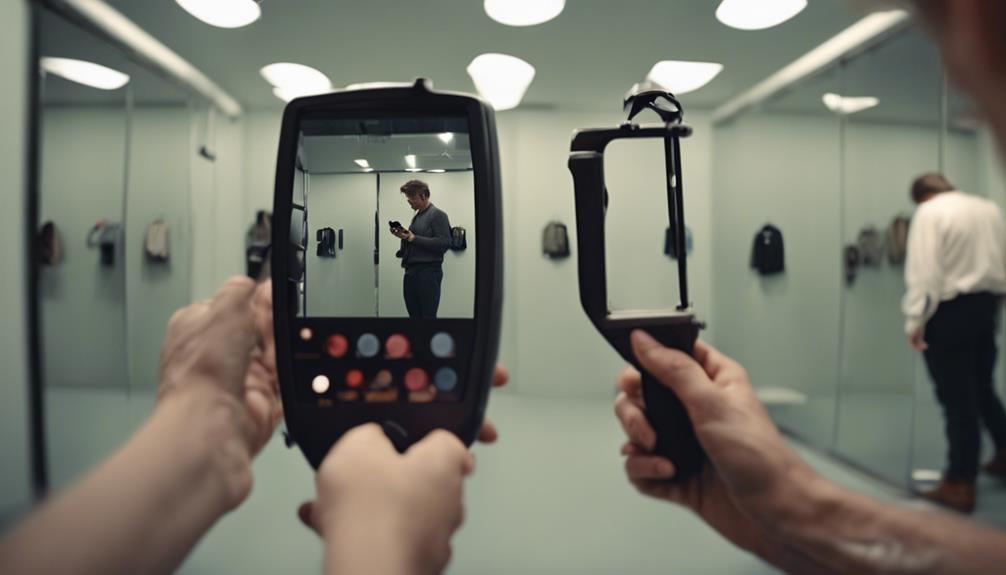
A dedicated hidden-camera detector can provide another way to inspect a room. Depending on the model, it may look for radio-frequency transmissions or help identify optical lenses through reflected light. Follow the manufacturer’s instructions and sweep slowly, concentrating on vents, outlets, fixtures, mirrors, and objects facing the changing area.
Detectors are not definitive. A device may miss a camera that is not transmitting, may not identify every type of camera, or may react to ordinary electronics. Treat an alert as a reason to investigate further, not as proof by itself.
What to do if you find something suspicious
Stop changing and leave the room if you feel unsafe. Do not confront a suspected offender or handle a device unnecessarily. From a safe location, note the room number, store, facility, and time, and report the concern to the manager or security staff. If you believe a camera is recording people without consent, contact the appropriate local authorities and preserve any photos or details you obtained safely. If you are with someone vulnerable, help them move to a private and secure location.
The most important step is to trust a credible concern. A careful inspection, combined with prompt reporting, is more useful than attempting to prove the device yourself.