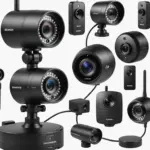

The smallest hidden camera with audio is not necessarily the best camera for every situation. Reducing the size of a device affects its lens, image sensor, microphone, battery, storage, and connectivity. A useful choice depends on how you plan to use it, how long it must operate, and whether you need local recording or remote access.
Miniature cameras should be used only for lawful, clearly justified purposes. Audio recording is subject to privacy and consent rules that vary by jurisdiction, and people may have a reasonable expectation of privacy in homes, workplaces, meetings, and other private settings. Before recording, check the applicable rules and obtain consent where required.
What makes a camera genuinely compact?
A small camera with audio combines a tiny image sensor and lens with a built-in microphone and a compact power source. Some are designed as standalone miniature video recorders, saving footage to internal storage or a microSD card. Others use Wi-Fi to send live video to a phone or store clips through an online service.
The housing may be designed for discreet placement, but the camera’s visible lens, microphone opening, power cable, and status lights still affect how practical it is. A smaller body can make installation easier, yet it may also leave less room for cooling, battery capacity, and better-quality components.
The main trade-offs of ultra-small cameras
Miniaturisation involves compromises. A very small lens and sensor may produce softer images or perform poorly in dim lighting compared with a larger camera. A narrow field of view can also make it harder to capture a wider area. If low-light recording matters, review the camera’s sensor performance, lens aperture, and any included illumination rather than judging it by size alone.
Audio quality has its own limitations. A microphone inside a small enclosure may record muffled speech, handling noise, or sounds generated by the device. Noise reduction can help, but it cannot completely overcome poor microphone placement or a noisy environment. If spoken audio is important, prioritise microphone quality and test recordings in the intended location.
Battery capacity is another major constraint. The smallest models may run for only a limited period, while larger devices or cameras connected to continuous power can operate longer. Motion-activated recording can reduce unnecessary recording and conserve power, although it may not capture every event.
Storage, wireless access, and security
A camera with local storage is often simpler to operate and does not require a network connection. You will need to remove the storage card or connect the device to retrieve files, but this arrangement can reduce dependence on wireless services.
Wi-Fi models may provide live viewing, phone notifications, and remote file access. These features consume more power and require careful account and network security. Use strong, unique credentials, update the device when updates are available, and avoid exposing recorded footage or live feeds to people who are not authorised to access them.
When comparing recording options, look for:
- Video resolution and frame rate appropriate for the scene
- Reliable file handling and loop-recording controls
- Accessible local storage or a clearly explained mobile app
- Motion detection that can be adjusted to reduce unnecessary clips
- Secure pairing and account controls for connected devices
Features to evaluate before buying
Start with the recording conditions rather than the smallest available dimensions. For a dark room, image quality and low-light performance may matter more than saving a few millimetres of space. For speech, examine the microphone design, audio settings, and how easily the device can be positioned without blocking the microphone.
Also consider whether the camera can be mounted securely, how files are transferred, and whether the battery can be replaced or recharged conveniently. A slightly larger model may be a better choice if it offers substantially longer runtime, clearer audio, or more dependable storage.
Lawful and responsible applications
Compact cameras can support legitimate monitoring when people are informed or when the use is otherwise permitted by applicable law. Examples may include checking on a property, documenting an authorised inspection, monitoring a delivery area, or recording a planned activity with the knowledge of participants.
Do not use a camera to secretly record private conversations, enter spaces where recording is prohibited, or monitor people without a lawful basis. Audio often creates stricter privacy concerns than video. If the intended use involves employees, tenants, visitors, family members, or professional meetings, obtain appropriate advice and consent before installation.
Finding the right balance
The smallest hidden camera with audio is a balance between physical size, recording quality, runtime, storage, and privacy. Choose the least intrusive device that meets the legitimate purpose, and do not assume that a smaller camera is automatically more capable. Clear audio, dependable power, secure file access, and lawful installation are usually more important than achieving the absolute minimum size.